How Artificial Intelligence is Redefining Enterprise Mobility?
Author: 42Gears Team
Among all latest technical advancements, Artificial Intelligence (AI) has been gaining lots of interest in the past few years. As per a report published by Gartner, “In Jan 2016, term “AI” did not even have enough search volume, but by May 2017, the term ranked at No. 7 among the top 100 searches”.
Most businesses today are actively exploring ways in which AI can add value to their processes. Numerous operations and activities in IT sector may soon be replaced or assisted by artificial intelligence such as desk service, application support, project and system administration. To reap the benefits of AI, CIOs and chief data officers (CDOs) are keen to make it a part of their digital business strategy. Gartner predicts that by 2020, AI will be among the top 5 investment priorities for more than 30% CIOs.
Artificial Intelligence has come a long way from the pages of science fiction to the toolkit of engineers, helping solve numerous real-life problems. Advances in Deep Learning has led to remarkable progress in Computer Vision and Natural Language Processing.
Major companies such as Google, Amazon, Apple and Microsoft have already proven the potentials of AI through their consumer products like, Echo, Siri and Cortana, respectively.
This paper tries to analyse the impact of Artificial Intelligence on enterprise mobility and applications. Will it really change the way enterprises use and manage mobility?
As per Gartner’s projection, by 2021, 40% of new enterprise applications implemented by service providers will include AI technologies. With the advent of new technologies such as smartphones, mobile apps, and IoT devices, operational tasks for organizations have become faster, easier and more efficient than ever. Over the last decade, companies all over the world have integrated mobility as an important element to their business model or to improve existing business processes. But recently, artificial intelligence, with its super-human like capabilities, is allowing everyone to think beyond these technologies, to overcome limitations and minimize the probability of errors.
AI promises to solve problems which are difficult for the human workforce. Here, we are not talking about a self-driven car or robotic security surveillance, but some smaller activities that could matter for an organization, such as AI chatbots that enable easy communication between a company and its prospects.
Contrary to popular notions that workers see AI as a threat to their jobs, modern workers wish to adopt and work with sophisticated AI products and software. AI products such as Apple’s Siri, Amazon’s Echo and Microsoft’s Cortana enable human assistance and offer users flexibility and enhanced productivity. This is similar to the events from a decade ago when mobility took the consumer world by storm. Employees pushing for the flexibility wanted to use their own devices for work as well giving rise to BYOD (Bring your own device).
How AI model works:
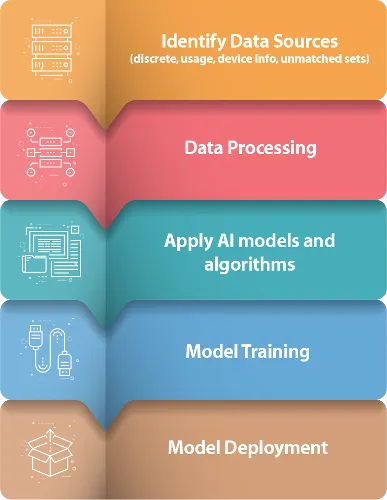
There is a standard procedure on how AI is implemented. First, AI must identify data from various sources such as usage, devices, discrete and unmatched sets. After identification, the data is processed and applied to AI models. Using machine learning algorithm, these models are trained to deal with various problems and finally, they are deployed to give outputs.
Capabilities of AI to improve mobility
AI in smartphones
Enterprises are extensively using smartphones with applications and other capabilities for businesses. In the last few years, smartphone manufacturers have started adding AI to enhance device efficiency. These phones are capable of understanding users’ habits to build app priority and rearrange apps as per user preferences. Also, they manage resources by prioritizing CPU, RAM and ROM to optimize device performance and close memory exhaustive apps running in the background.
Recently, Huawei launched Huawei Mate 9, the smartphone with AI capabilities to focus on enterprise customers. This phone, with machine learning power, can perform fine-grained scheduling to maximizes computing efficiency. It recycles memory resources automatically, creating more memory for priority apps.
Sentiment Analysis
Sentiment Analysis used for app analytics helps to gain understanding of the attitudes, opinions and emotions expressed by customers. Enterprises and app developers can transfer the burden of checking and managing app reviews to Appbot. It can provide the most relevant content and features by analyzing the sentiments of the customers.
Automated reasoning
Automatic reasoning is a subfield of Artificial Intelligence in which computer programs are produced to reason completely and automatically. For example, Uber uses Automated Reasoning to optimize routes and drive the passengers faster to their destinations. The AI algorithms picks up data from Uber drivers who travel similar routes, understands the patterns and saves it for future trips.
Data Mining and Predictive Analytics
The purpose of data mining is to analyze big data and to generate meaningful and interesting conclusions. Data storage, maintenance and analyzing data are some important tasks performed by data mining. AI provides a set of tools and the learning algorithms to discover all possible relationships.
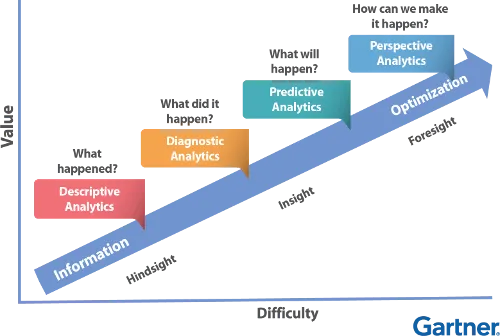
Data mining has turned towards a new approach that is predictive analysis. Gartner's approach to Predictive Analysis is as follows: “Predictive analysis is an approach to data mining that emphasizes on prediction rather than describing, classifying and clustering them”. The traditional approach of AI has to change now, from descriptive to prescriptive analytics. This can be only possible by applying AI models in data mining.
For example, devices consuming high battery, or any pattern that has the potential to cause device failure can be prevented through AI.
Anomaly Detection
Artificial intelligence plays a crucial role in providing a defence to the system against external threats and abnormalities. It continuously watches over ongoing activities, detect anomalies and triggers the alarm. With the deepest knowledge on enterprise’s topology, dynamic baseline performance and behavior, AI automatically identifies anomalies that matter for a particular enterprise environment.
Automatically Prioritize Problems
By applying learning models and algorithms, AI can automatically determine whether an issue or problem has an actual impact on the system. AI prioritizes problems as per preferences and tries to fix them rather than wasting time to find them.
Chatbots
The popularity of chatbots are growing as enterprises seek to automate functions such as communications and customer service. Companies such as KLM Airlines and Taco Bell have been using these bots to book flights, order foods and inquire on services respectively. In the mobile ecosystem, chatbots can be considered as equivalent to apps.
Voice and messaging technologies are being extensively used by enterprises due to capabilities such as ease of integration, security, management and monitoring. Similarly, chatbots can also offer these benefits to the enterprises. Chatbots platforms can include capabilities such as integration with enterprise systems and voice and messaging platforms, chatbot store, language learning systems and provide a secured platform.
Challenges to Implement AI in Enterprises
Though AI adoption is growing, there are certain challenges that need to be address before implementation:
Restructure IT Operations
As aforementioned, some of the IT operations will eventually be replaced by AI. Due to improvement in work efficiency, some roles will become redundant and will be replaced by AI. CIOs must identify the IT functions which can be better utilized by Artificial Intelligence and list down the factors that should remain untouched to mitigate disruptions caused by AI.
Security Concerns
With the increase in the pervasiveness of chatbots, IT should ensure that the chatbots are secure enough to not harm the corporate data. Companies should focus on controlling sensitive information and hence they require an authenticate bot that can ensure security of data.
Requirement of a Skilled Team
Organizations may not be fully technically skilled/equipped to develop and deploy AI solutions. As per a survey from Gartner, “More than half respondents said that lack of skills in staffs was the top challenge in adopting AI into organization”. Also, before implementing AI into the enterprise ecosystem, data officers have to enhance the capabilities of present employees in terms of analytical thinking. And, for data management, companies will require a skilled team of data engineers and data scientists.
AI Washing
To explore the opportunities awarded by the term ‘AI for business’, many startups and vendors are exaggerating the implementation of Artificial Intelligence in their products. As per a Gartner report, vendors are “AI washing” by applying label on their products which can impact investment in the technology. The buyers get confused when they don’t find real AI solutions and might avoid investing in AI technology based products in the future.
Conclusion
Many MDM vendors are now incorporating AI features in their offerings to improve operational efficiency. 42Gears is the first EMM vendor that has recently launched virtual assistance chatbot ‘Deepthought’.
DeepThought chatbot simplifies the process of EMM interaction. It helps users navigate through the maze of myriad functionalities and complex workflow quickly. DeepThought minimizes the process of information querying by offering the ability to simply type or voice a requirement. It captures all queries in its database and uses Natural Language Processor (NLP) to convert natural language sentences into SureMDM commands. The chatbot will learn and improve user experience over time. Overall IT admins would benefit as they would require considerably less training to adopt EMM solutions for their business.